

Sports Injury Osteopathy in Crowborough and Rotherfield
A sports injury can interrupt training, affect everyday activities and make it difficult to return to the exercise you enjoy. Whether you run, cycle, play team sports, train at the gym or exercise recreationally, an assessment can help you understand your symptoms and plan your next steps.
At TQ Osteopathy, I provide individual osteopathic assessment and care in the heart of Rotherfield, near Crowborough, East Sussex.
Your appointment focuses on understanding your injury, your activity levels and what you would like to return to. We will discuss whether osteopathic care is suitable and agree a management plan tailored to your needs.
Common sports injuries
Sports injuries may happen suddenly, such as when twisting an ankle or sprinting, or develop gradually with repeated activity.
Problems that may be assessed include:
Muscle strains and tears
Ligament sprains
Tendon-related pain
Shoulder pain associated with exercise
Hip, knee, ankle or foot pain
Back and neck pain affecting training
Persistent discomfort when returning to activity after an injury
A strain affects a muscle or tendon, while a sprain affects a ligament—the tissue connecting bones at a joint. A careful assessment helps distinguish these problems and identify when further medical investigation is needed.
How osteopathic assessment and care may help
Your initial appointment includes a discussion of your symptoms, medical history, training and goals, followed by an appropriate physical assessment with your consent.
Depending on your individual circumstances, your management plan may include:
Advice on temporarily modifying training or everyday activities
Gentle hands-on techniques where appropriate
Individualised mobility and strengthening exercises
Balance and movement-control exercises where relevant
Guidance on gradually rebuilding activity
A plan for reviewing progress and returning to your sport
The emphasis is on supporting movement, function and a gradual return to activity. Treatment is tailored to the individual, and no particular outcome or recovery time can be guaranteed.
If a fracture, significant tendon rupture or another injury requiring specialist care is suspected, medical assessment will be recommended rather than routine treatment.
Muscle tears and injury grades
Muscle injuries are often described using a simplified three-grade system. Grading systems vary, so a grade should not be treated as an exact prediction of recovery time. The affected muscle, injury location and demands of your sport also matter.
Grade 1: mild strain
A mild injury involving a limited amount of muscle-fibre damage. Recovery may be relatively quick, but a gradual return to demanding activity is still important.
Grade 2: partial tear
A more substantial injury involving a partial muscle tear. Rehabilitation usually takes longer than for a mild strain and needs to rebuild strength and tolerance to activity.
Grade 3: severe tear or complete rupture
In a simplified three-grade system, this describes the most severe injuries. Prompt assessment is important, and specialist management may be needed.
Less severe muscle injuries may improve over days to weeks, while more substantial tears can take weeks or several months. These are broad guides, not guarantees or clearance to return to sport.
How long do sports injuries take to recover?
There is no single healing time that applies to every muscle, tendon or ligament injury. Recovery also involves rebuilding strength, movement and confidence—not simply waiting for pain to settle.
Muscle injuries
Recovery depends on the muscle involved, the extent and location of the injury, and whether nearby tendon tissue is affected. For example, NHS guidance notes that calf strains commonly take around six weeks to heal, but some take up to twelve weeks. This should not be applied as a universal timetable for every muscle injury.
Ligament sprains
Ligament injuries vary from mild stretching to complete tears. Ankle sprains may recover over several weeks, while severe sprains can take several months. Balance, strength and stability may need further rehabilitation before returning to sport.
Tendinopathy
Tendinopathy describes a painful tendon problem and is not the same as a complete tendon tear. University Hospitals Sussex advises that many straightforward tendon problems improve over approximately twelve weeks, but some take several months to respond.
Tendon tears and ruptures
Partial tendon tears, complete ruptures and surgically repaired tendons need an individual management plan. Recovery depends on the tendon involved and the treatment required; a timetable for one tendon repair should not be applied to another. Follow the advice of your treating specialist and rehabilitation team.
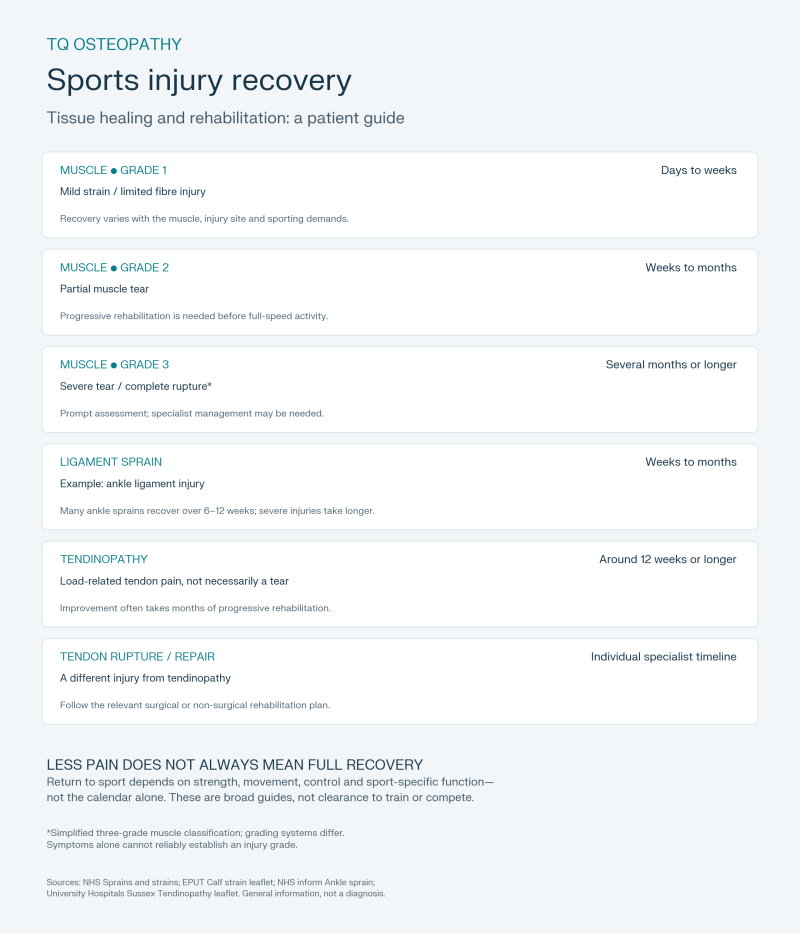
Recovery times are approximate. Your symptoms, injury severity, strength, movement and sporting demands will guide your rehabilitation. Feeling less pain does not always mean the tissue is ready for full training or competition.
Returning to training and sport
Returning too quickly can increase the risk of further injury. Your return should be gradual and based on your ability to manage the demands of your activity, rather than a date alone.
Depending on your injury, we may review:
Comfortable movement and everyday activities
Strength and control in the affected area
Balance and stability
Your response to progressively harder exercise
Sport-specific tasks, such as running, changing direction or lifting
For example, NHS calf-strain advice recommends regaining full strength and movement, and being able to walk briskly without pain or swelling, before returning to an active hobby. The requirements for your own sport may be more demanding.
When to seek urgent medical advice
Contact NHS 111 urgently after an injury if:
Pain is severe or getting worse.
There is substantial or increasing swelling or bruising.
You cannot put weight on the injured area or walk more than a few steps.
The area is very stiff or difficult to move.
You have a high temperature or feel hot, cold or shivery.
Symptoms are not improving with self-care.
Go to A&E or call 999 if you heard a crack during the injury, the injured area has changed shape, it is numb or tingling, or the skin has become blue, grey or cold. These symptoms may indicate a fracture or another serious injury requiring urgent assessment.
Do not wait for an osteopathy appointment if urgent assessment is needed.
About Thomas Snook
Thomas Snook is an osteopath registered with the General Osteopathic Council.
At TQ Osteopathy, the emphasis is on individual care: taking time to understand your concerns, explaining the assessment clearly and discussing appropriate options with you.
Arrange an appointment
If an injury is affecting your training or everyday activities, please get in touch to discuss whether an osteopathic assessment may be appropriate.
Telephone: 07493 796676
Email: tqosteo@gmail.com
TQ Osteopathy
Rotherfield, East Sussex
References and further reading
NHS — Sprains and strains
. Advice on symptoms, early management, recovery and when to seek urgent help.
Sherwood Forest Hospitals NHS Foundation Trust — Muscle strains
. Patient information on muscle injuries, rehabilitation and return to activity.
NHS Ayrshire & Arran — Ankle sprain
. Guidance on ligament injury and recovery.
Sherwood Forest Hospitals NHS Foundation Trust — Achilles tendinopathy
. Advice on progressive rehabilitation, timescales and signs of rupture.
Lancashire Teaching Hospitals NHS Foundation Trust — Achilles tendon rupture information
. Information on rehabilitation and return to sport.
Leeds Community Healthcare NHS Trust — Return to activity or sport after injury
. An explanation of healing stages and recovery.